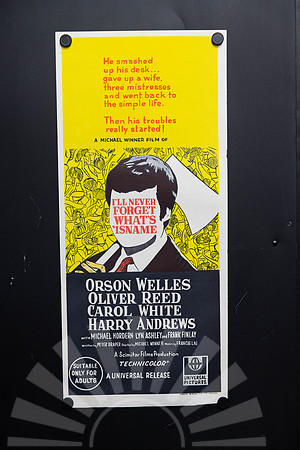
BB17-085 — I’LL NEVER FORGET WHAT’S ’ISNAME
Shop Now YEAR: 1967
FILM STUDIO / PRODUCTION: Scimitar Films / Universal Pictures
TAGLINE: “He smashed up his desk… gave up a wife, three mistresses and went back to the simple life. Then his troubles really started!”
DIRECTOR: Michael Winner
CAST: Oliver Reed, Orson Welles, Carol White, Harry Andrews, Michael Hordern, Lyn Ashley, Frank Finlay, Wendy Craig, Marianne Faithfull
SCREENPLAY: Peter Draper
PRODUCER: Michael Winner
MUSIC: Francis Lai
CINEMATOGRAPHY: Otto Heller
GENRE: Comedy-Drama / Satire
POSTER PRINTER: Robert Burton Pty. Ltd., Sydney
FORMAT: Australian Daybill
I’ll Never Forget What’s ’Isname is Michael Winner’s 1967 British satire starring Oliver Reed as a successful London advertising executive who abandons his career and complicated private life, only to discover escaping his former world isn't so simple. Orson Welles plays his formidable advertising boss, Jonathan Lute.
POSTER DESIGN FEATURES: A fantastic late-1960s Australian design dominated by bright yellow, black, red and white. Oliver Reed's illustrated head forms the central image, with the film title replacing his facial features, surrounded by a mass of stylised women. The stark black lower panel gives prominent billing to Orson Welles, Oliver Reed and Carol White, while the Australian “Suitable Only for Adults” classification remains clearly visible.
COLLECTOR'S NOTE: A particularly strong piece of Swinging London-era satire, bringing together Oliver Reed, Orson Welles and Carol White, with Marianne Faithfull and Edward Fox also appearing in the cast. The film tackles advertising, consumerism and the conflict between commercial success and personal freedom, giving this unusually graphic Australian poster a strong connection to the visual culture of the late 1960s.